Why it pays to understand your prescription
After every eye test, you are legally entitled to receive a copy of your optical prescription. This small card or slip of paper contains all the information needed to make your glasses or order contact lenses, and it belongs to you regardless of where you choose to buy your eyewear. Yet for many people, the prescription is a bewildering string of numbers, abbreviations, and symbols that might as well be written in code.
Understanding what your prescription means empowers you to make informed decisions about your eye care. You can compare prices confidently, order glasses online with peace of mind, check that your lenses have been made correctly, and track how your vision changes over time. It also helps you have more meaningful conversations with your optometrist and ask the right questions about your eye health.
This guide will walk you through every element of a standard UK optical prescription, explain what each number means in practical terms, and give you the confidence to read and interpret your own results.
The layout of a prescription
A UK optical prescription is typically presented in a table format with separate rows for each eye. The right eye is labelled "R" or "RE" (sometimes "OD," from the Latin oculus dexter), and the left eye is labelled "L" or "LE" (sometimes "OS," from oculus sinister). If a measurement applies to both eyes together, it may be labelled "OU" (oculi uterque).
The main columns you will encounter are SPH (sphere), CYL (cylinder), AXIS, and ADD (addition). Some prescriptions also include a PRISM value and a BASE direction, though these are less common. Each of these measurements is expressed in dioptres (abbreviated "D" or "DS"), which is the unit used to describe the optical power of a lens. Let us look at each one in detail.
SPH — the sphere value
The sphere value indicates the main focusing power of the lens needed to correct your distance vision. It tells you whether you are short-sighted (myopic) or long-sighted (hypermetropic), and by how much.
A negative sphere value (for example, -2.00) means you are short-sighted. The higher the number after the minus sign, the more short-sighted you are. A prescription of -1.00 is a mild degree of short-sightedness, while -6.00 or above is considered high myopia. Short-sighted people can see nearby objects clearly but struggle with distance, such as reading road signs or seeing the television from across the room.
A positive sphere value (for example, +1.50) means you are long-sighted. Long-sighted people may struggle with close-up tasks such as reading, and in more significant cases, distance vision can also be affected. Young people with mild long-sightedness often do not notice it because their eye muscles can compensate by working harder, but this extra effort can cause headaches and eye strain.
If the sphere value is zero or labelled "plano" (abbreviated "Pl"), your eyes do not need spherical correction for distance, though you may still need correction for astigmatism or reading.
CYL and AXIS — astigmatism correction
The cylinder and axis values work together to correct astigmatism, a common condition where the cornea or lens is shaped more like a rugby ball than a football. This uneven curvature causes light to focus at two different points rather than one, resulting in blurred or distorted vision at all distances.
The CYL value indicates the amount of astigmatism, expressed in dioptres. It can be negative or positive depending on the notation convention used by your optometrist. A CYL of -0.50 is very mild astigmatism, while -3.00 or more is significant. Many people have some degree of astigmatism, and small amounts may not require correction.
The AXIS value is a number between 1 and 180 that specifies the angle at which the cylindrical correction is positioned, measured in degrees. Think of it as the compass direction of the astigmatism. The axis value has no meaning without the cylinder value and vice versa; they are always used together.
If both CYL and AXIS are blank or zero on your prescription, congratulations: you do not have astigmatism, or at least not enough to require correction.
ADD — the reading addition
The ADD value appears on prescriptions for people who need different lens powers for distance and near vision, which is virtually everyone over the age of about 45. It represents the additional focusing power, on top of the distance prescription, required for comfortable reading and close work. The ADD is always a positive number and is the same for both eyes.
Typical ADD values range from +0.75 for someone in their early 40s who is just beginning to notice reading difficulties, up to +2.50 or +3.00 for someone in their 60s or older. The ADD value gradually increases over the years as the crystalline lens inside the eye continues to stiffen, eventually reaching a plateau in the late 60s.
If you have an ADD value on your prescription, you will need either separate reading glasses, bifocals (with a visible line separating the distance and near sections), or varifocals (also called progressive lenses, which provide a seamless transition from distance to near). Your optician can help you choose the best option for your lifestyle and visual needs.
PRISM and BASE
Prism is prescribed for people who have a binocular vision problem, meaning their two eyes do not work together perfectly as a team. Symptoms can include double vision, eye strain, headaches, and difficulty with depth perception. A prism bends light to shift the image so that the two eyes can fuse the images more easily.
The prism value is measured in prism dioptres, and the BASE direction indicates which way the thickest part of the prism should be oriented: base up (BU), base down (BD), base in (BI), or base out (BO). Prism prescriptions are less common than sphere, cylinder, and ADD values, and if your prescription does not include prism, that simply means your binocular vision is working well.
Pupillary distance
Your pupillary distance (PD) is the measurement, in millimetres, between the centres of your two pupils. This measurement is essential for positioning the optical centres of your lenses correctly in front of your eyes, which ensures optimal visual performance and comfort. A typical adult PD ranges from about 54mm to 74mm.
Some opticians include the PD on the prescription card, while others do not. If you are planning to order glasses online, you will need this measurement. You can ask your optician to include it on your prescription, measure it yourself using a ruler and a mirror, or use one of the many smartphone apps designed for the purpose. Be aware that some opticians may charge a small fee to measure your PD if you request it separately from your eye test.
What the numbers mean for your daily life
Understanding the numbers is useful, but what really matters is how your prescription translates into everyday experience. A mild prescription of -1.00 or +1.00 will have a noticeable but modest impact on your vision, and you may not need to wear glasses all the time. A moderate prescription of -3.00 or +3.00 will significantly affect your ability to see clearly without correction, and you will likely wear glasses or contact lenses for most activities. A high prescription of -6.00 or above, or +5.00 or above, means your uncorrected vision is quite poor, and you will depend on your glasses or contact lenses for virtually everything.
If your prescription has changed since your last eye test, do not be alarmed. Small changes of 0.25 to 0.50 dioptres are normal fluctuations and may or may not warrant new lenses. Larger changes may indicate that your eyes are still changing, which is common in younger people, or that a condition needs monitoring. Your optometrist will advise you on whether a change is clinically significant and whether new glasses are recommended.
Keeping your prescription up to date
Your optical prescription is valid for two years from the date of the eye test for adults, and for one year for children under 16. After this period, you should have a new eye test before ordering replacement glasses or contact lenses, as your prescription may have changed. Using an expired prescription could result in glasses that no longer provide the best possible vision, and in the case of contact lenses, an outdated prescription could potentially cause discomfort or harm to your eyes.
Store your prescription somewhere safe and accessible. Photograph it on your phone as a backup, and keep a note of the date it was issued and when it expires. When the expiry date approaches, book your next eye test promptly to ensure continuity of care and to maintain the clearest, most comfortable vision possible.
Understanding additional results
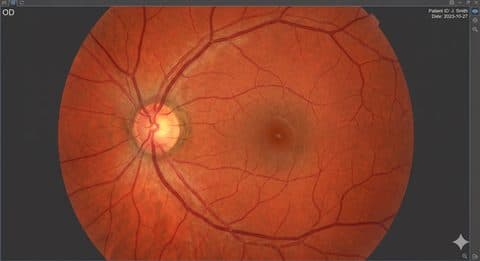
Beyond the prescription itself, your optometrist may provide additional information about the health of your eyes. This could include your intraocular pressure readings (measured in mmHg, with normal values typically between 10 and 21), the results of your visual field test, photographs or scans of your retina, and notes about any conditions or findings that were observed during the examination.
If your optometrist mentions terms like cup-to-disc ratio (used in glaucoma assessment), drusen (deposits associated with macular degeneration), or nuclear sclerosis (early cataract changes), do not hesitate to ask for a clear explanation in everyday language. A good optometrist will be happy to explain their findings and what they mean for your eye health going forward. Knowledge is power, and the more you understand about your results, the more actively you can participate in looking after your vision.